National Science Foundation Grant Division of Graduate Education DGE-1922642 (September 2019 – August 2025)
Center for Plant Cell Biology – UC Riverside
Discover. Design. Deploy. A graduate training program for biologists, engineers, and computational scientists.
Mission
To equip graduate students in biological sciences and engineering programs with the knowledge and skills to combine plant and microbial biology with engineering technologies to discover, design, and deploy plant-inspired solutions for agriculture and biotechnology.
Trainees



Chase Lenert-Mondou
Biochem. Mol. Biol.
Melissa Gomez
Microbiology
Amirsadra Mohensi
Computer Science
I am interested in the genetic engineering of micro-organisms, such as yeast
My motivation in joining the Plants 3D program is to develop the skills needed to make discoveries in foundational knowledge of photosynthesis.
As a computer scientist, I develop tools that process and explain the deluge of genomic information extracted from various organisms.


Anqi Zhou
Chem. Env. Eng
William Samson
Plant Pathology
Lida Halilovic
Plant Pathology
The beauty of being an engineer is all about how those scientific discoveries in the biology-related field can be applied creatively and solve pressing problems in the real world.
My new research focus is on providing growers with new information to improve the biological and physical qualities of soil health.
My goals are to advance the field of knowledge in how plants protect themselves from pathogens to develop novel and environmentally friendly crop protection solutions.


Isaac Diaz
Plant Biology
Xiaoxuan Teng
Chem. Env. Eng
Marina Youngblood
Plant Biology
I am interested in working to combat citrus greening disease, which has decimated the citrus industry in Puerto Rico and Florida.
As a chemical engineer, I am interested in novel plant natural products (NPs) discovery which would potentially show some medicinal value.
I hope to collaborate with fellow Plants 3D students to expand nanoparticle application in current agricultural practices.


Roxanna Pignolet
Microbiology
Jean Ae “Ruth” Kim
Plant Biology
Rachel Strout
Plant Biology
The Plants3D program will
provide valuable support and training to both help me improve my science communication skills and make impactful connections with an innovative and interdisciplinary community.
My research goal is to uncover
the function of nuclear photo bodies as gene regulatory hubs so that my findings can be applied to improve crop tolerance to environmental stressors.
My research focuses on how
model and crop plants respond to heat in a time-of-day-dependent manner. I am interested in exploring its implications in designing heat-resistant crops through the Plants3D program.
Program Overview and Highlights
Final Year Training Activities – Reverse Chronological Order
6 June 2025 – Plants3D Final Symposium and Celebration with guest speaker Robert van Buren, Michigan State University
14 April 2025 – Joseph Swift – Nuts and Bolts of a Start-Up in Ag (a personal journey of a plant biologist)
7 February 2025 – Trevor Nolan, Caltech
31 January 2025 – Robin Buell, U of Georgia
December 13th | CEPCEB 22th Annual Research and Awards Celebration featuring Ken Birnbaum from NYU as the Noel T. Keen Distinguished Speaker
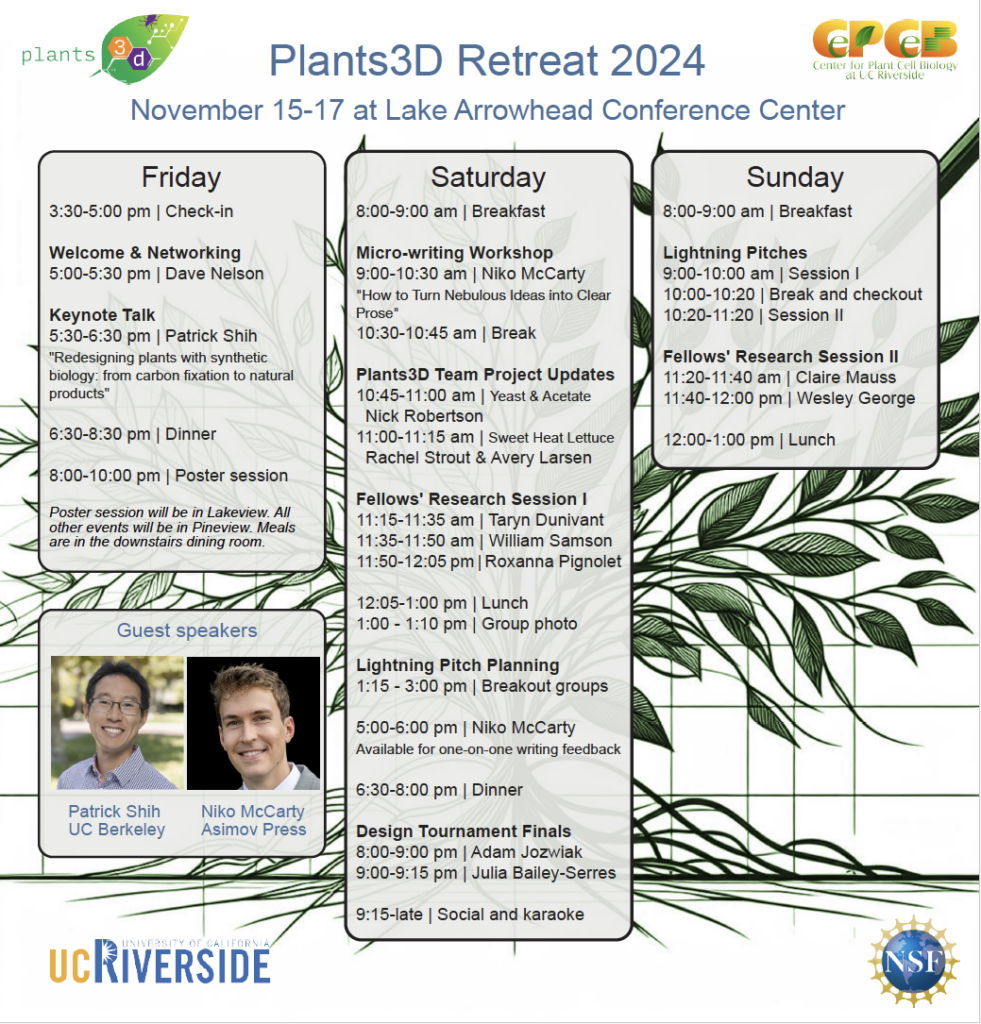
Plants3D 6th Retreat – 15-17 November 2024 (All Retreats)
- 2024 Design Tournament – Adam Jozwiak
- 20 September 2024 | Fall Kickoff Event
- 18 October 2024 | Round 1
- 01 November 2024 | Semi-finals
- Final Round @ 2024 Retreat!
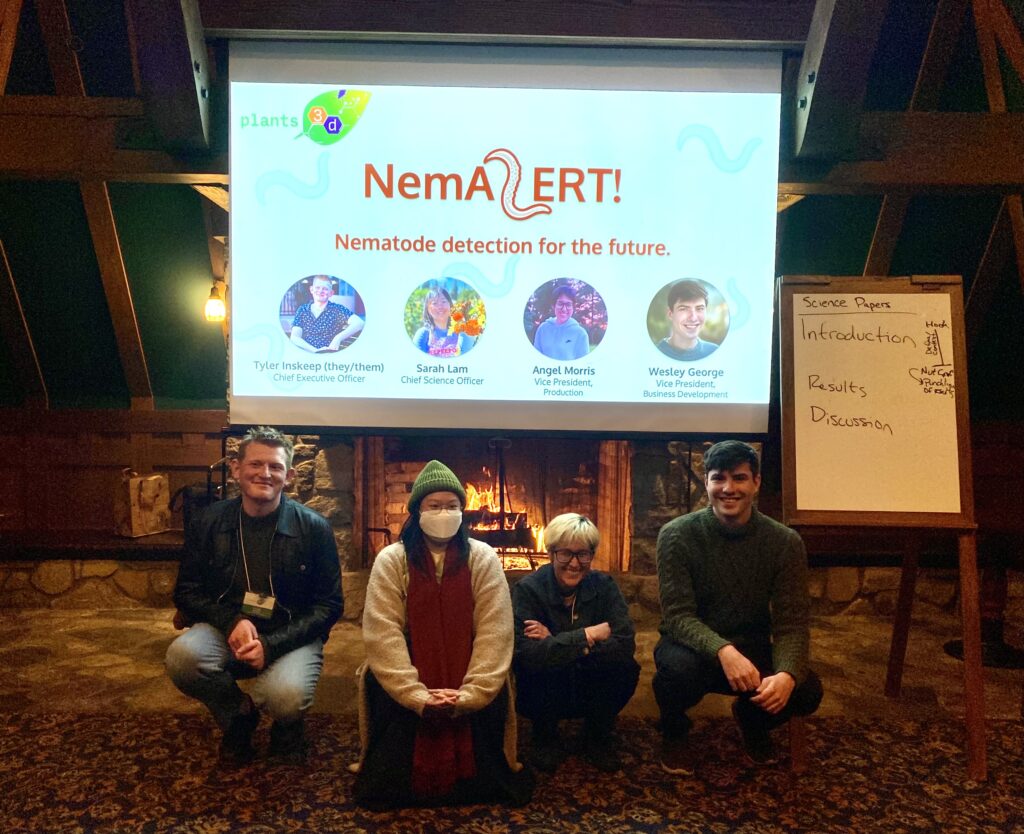
- The winning project, NemALERT! will be provided seed funding. Project envisioned byTyler Inskeep, Sarah Lam, Angel Morris and Wesley George.
Communication
Spring 2024
Design and Entrepreneurship Course
BPSC/CEE204 – Year 5
Communication Workshops
